Address
304 North Cardinal St.
Dorchester Center, MA 02124
Work Hours
Monday to Friday: 7AM - 7PM
Weekend: 10AM - 5PM

Address
304 North Cardinal St.
Dorchester Center, MA 02124
Work Hours
Monday to Friday: 7AM - 7PM
Weekend: 10AM - 5PM

 Byadmin
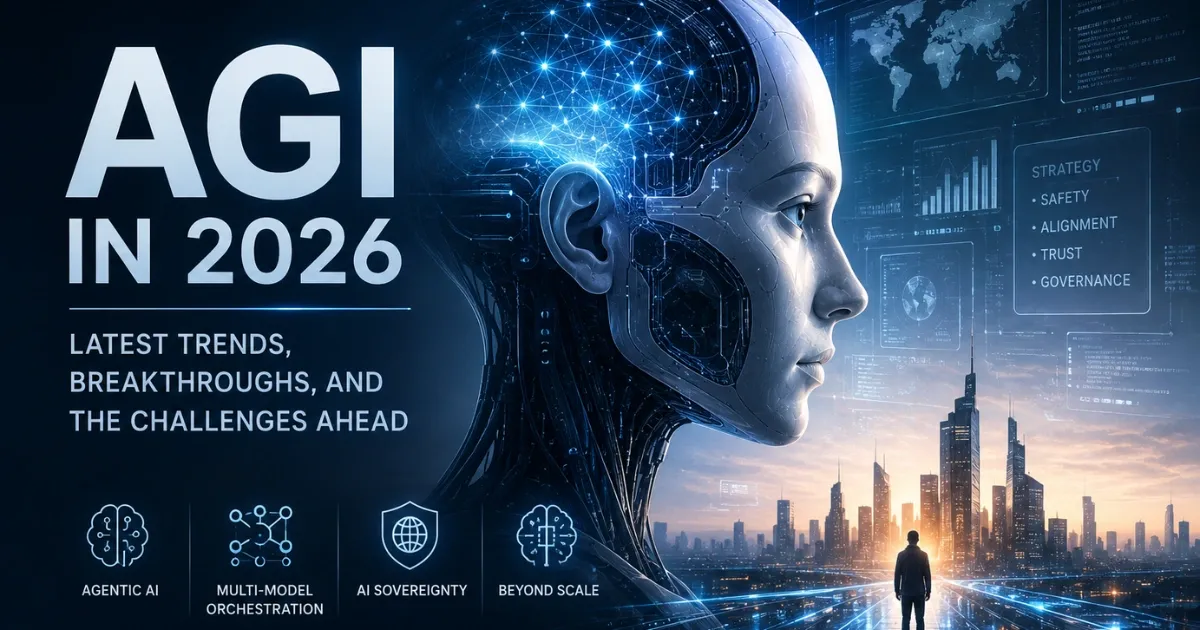
Artificial General Intelligence (AGI) has moved from a theoretical discussion to one of the most actively pursued ambitions in technology. Unlike today’s AI systems that excel at specific tasks, AGI refers to systems that can learn, reason, adapt, and solve problems across domains with capabilities approaching human-level flexibility. While true AGI has not yet been achieved, 2026 is becoming a defining year in shaping the path toward it.
Current AI models can write code, generate content, analyze documents, and automate workflows. AGI raises the ambition further: a system that can transfer knowledge across disciplines, learn continuously, make decisions in unfamiliar situations, and potentially operate with limited supervision.
The opportunity is enormous—accelerated scientific discovery, personalized healthcare, autonomous enterprise operations, and entirely new forms of productivity. At the same time, the technical and governance questions have become equally significant.
The biggest change in 2026 is the move from “answer generation” toward “action execution.”
AI systems are increasingly designed as agents capable of planning, using tools, executing multi-step workflows, and adapting based on outcomes. Instead of generating content only, these systems aim to complete business processes end-to-end.
Examples include:
This evolution is pushing AI closer to characteristics associated with general intelligence.
A growing school of thought suggests AGI may not emerge from one giant model.
Instead, organizations are exploring orchestration architectures where multiple specialized models collaborate under an intelligent coordination layer. This approach improves flexibility, resilience, and performance across diverse tasks.
The future may look less like one “super brain” and more like an intelligent operating system coordinating many expert capabilities.
Countries are increasingly treating advanced AI infrastructure as strategic national capability.
Governments and enterprises are investing in local compute, sovereign models, and regional AI ecosystems to reduce dependence on a small number of global providers. This trend is accelerating infrastructure investment and changing the economics of AI development.
This creates a new competitive landscape:
For years, larger models meant better performance.
But researchers increasingly argue that scale alone may not unlock AGI. New directions include:
The focus is shifting from bigger models to adaptable cognitive systems.
AI systems still produce incorrect outputs with confidence. For AGI to become practical, reliability must approach production-grade standards in high-stakes environments.
One of the hardest questions remains: how do we ensure advanced systems act in ways aligned with human intentions and diverse societal values?
Researchers increasingly view alignment as both a technical and philosophical challenge.
As AI agents become more capable, risks expand:
Security frameworks are becoming as important as model performance.
A major obstacle is defining success.
There is still no universal agreement on what qualifies as AGI or how to measure it consistently. Predictions remain highly varied across researchers and institutions.
There is no consensus.
Some leaders and forecasts expect AGI-like capabilities to emerge over the next few years, while others argue current systems remain fundamentally limited despite rapid progress.
What appears increasingly clear is this:
The race is no longer only about building smarter models. It is about building systems that are trustworthy, adaptable, governable, and useful at scale.
The organizations that succeed may not be the ones with the biggest models—but the ones that combine intelligence, orchestration, safety, and real-world execution.
AGI may not arrive in a single breakthrough moment. It may emerge gradually through agents, multimodal systems, orchestration, and continuous learning—until one day the distinction between AI and general intelligence becomes difficult to define.