Address
304 North Cardinal St.
Dorchester Center, MA 02124
Work Hours
Monday to Friday: 7AM - 7PM
Weekend: 10AM - 5PM

Address
304 North Cardinal St.
Dorchester Center, MA 02124
Work Hours
Monday to Friday: 7AM - 7PM
Weekend: 10AM - 5PM

 Byadmin
Organizations invest heavily in accounts payable automation software, AI invoice processing software, and ERP integrated invoice processing software expecting faster approvals and touchless operations.
Yet one issue continues to slow invoice throughput and increase operational cost:
3-way match exceptions.
Many AP teams automate invoice capture but still rely on manual intervention to resolve mismatches between purchase orders, receipts, and invoices.
The result:
This article explores the real causes behind exceptions and what enterprises should focus on beyond automation.
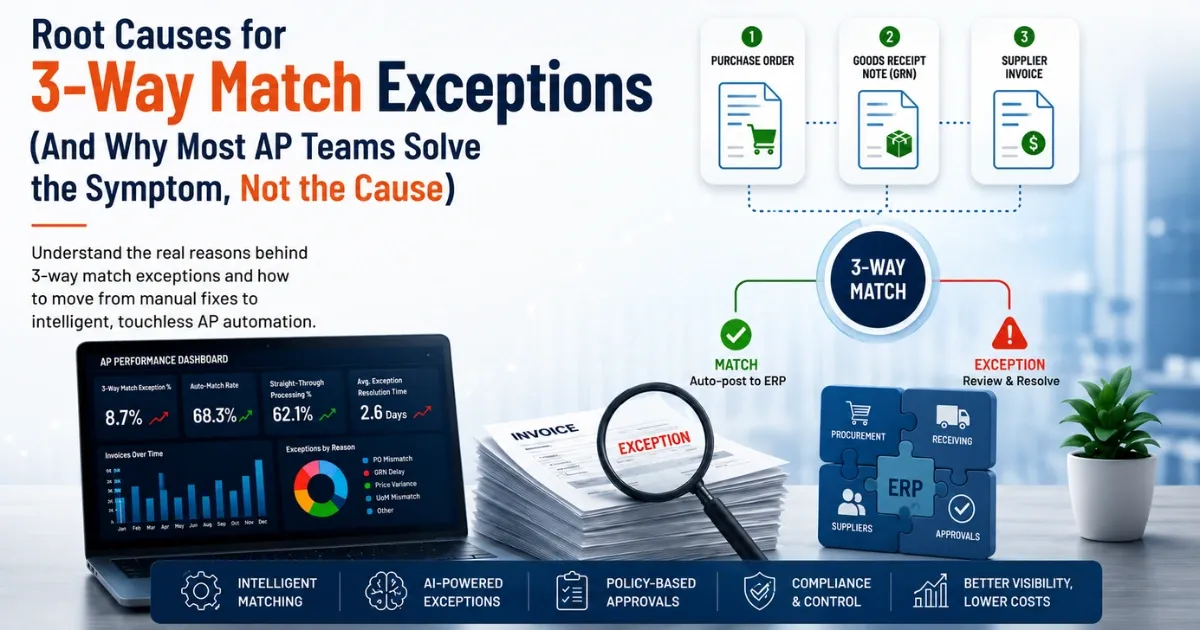
3-way matching validates three business records before invoice posting:
Modern 3-way matching automation software and automated invoice matching PO and GRN solutions attempt to perform this validation automatically before posting into ERP.
The challenge is not matching.
The challenge is handling exceptions.
Most AP exceptions originate upstream.
Common examples:
Even the most advanced AI invoice data extraction tool cannot correct poor source data.
Impact:
This is one of the most common causes of blocked invoices.
Typical scenario:
This creates unnecessary AP follow-up cycles.
Modern invoice posting automation tools and invoice exception management software increasingly monitor receipt delays and proactively route exceptions.
Supplier invoices rarely follow standard structures.
Challenges include:
This is where OCR invoice processing software reaches its limit.
Organizations are moving toward AI invoice processing software that understands document context rather than static extraction templates.
Example:
Commercially valid.
Systemically rejected.
This creates hidden manual effort.
Advanced AI tools for accounts payable automation increasingly introduce business-rule intelligence to normalize these variations automatically.
Modern supply chains rarely operate on one PO → one invoice.
Examples:
Legacy workflows struggle with many-to-many relationships.
This is where touchless invoice processing solutions differentiate themselves.
Organizations frequently blame suppliers.
Actual issue:
Approval design.
Examples:
Modern invoice approval workflow software uses exception routing and policy automation to reduce unnecessary approval delays.
Invoice automation succeeds only when connected to transaction systems.
Disconnected processes often create:
Organizations increasingly adopt invoice automation software for SAP, Oracle, and NetSuite to improve straight-through processing and reduce operational friction.
Exceptions are not just efficiency problems.
They create financial exposure.
Common risks:
Modern AP teams increasingly evaluate:
The objective shifts from automation to controlled automation.
Move beyond invoice volume.
Measure:
These indicators help teams identify opportunities to reduce invoice processing costs through software-driven automation.
The market is moving beyond extraction.
Leading enterprises are adopting:
The goal is no longer faster invoice capture.
The goal is touchless invoice processing with controlled exception management.
3-way match exceptions are rarely invoice problems.
They are process signals across procurement, receiving, suppliers, approvals, and ERP governance.
Organizations that combine accounts payable automation software, AI invoice processing software, and intelligent exception management create measurable gains in cost, compliance, and cash flow.
That is where AP transformation is heading in 2026.