Address
304 North Cardinal St.
Dorchester Center, MA 02124
Work Hours
Monday to Friday: 7AM - 7PM
Weekend: 10AM - 5PM

Address
304 North Cardinal St.
Dorchester Center, MA 02124
Work Hours
Monday to Friday: 7AM - 7PM
Weekend: 10AM - 5PM

 Byadmin
Most enterprises that invest in AI invoice processing software or accounts payable automation software see fast early wins.
Invoice capture improves. Data extraction accuracy goes up. Manual entry drops.
Then progress stalls.
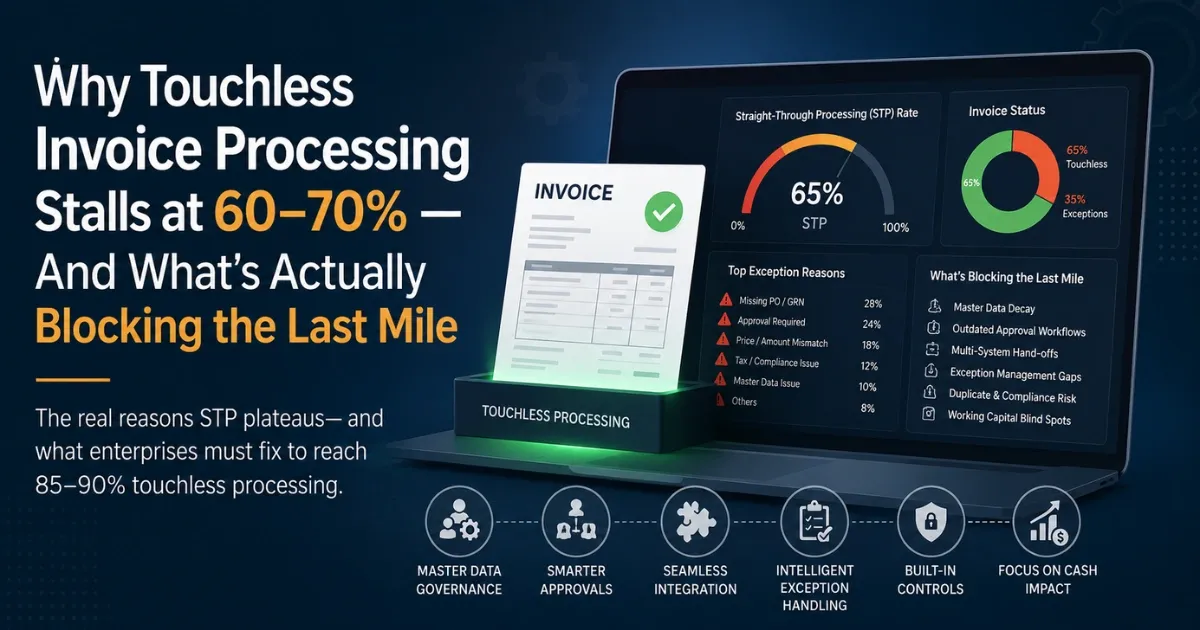
Straight-through processing (STP) plateaus somewhere between 60% and 70% — and stays there.
Finance leaders are often told the next jump to 85–90% STP just needs “better OCR” or “a smarter model.” In most environments, that’s not the real constraint.
This article looks at why the last mile of touchless invoice processing is the hardest 30%, and what enterprises actually need to close that gap.
A touchless invoice is one that moves from receipt to posting with zero human intervention: extraction, matching, validation, and approval all happen without a person opening the invoice.
Vendors selling AI invoice data extraction tools often report extraction accuracy in isolation. But extraction accuracy is not the same as STP rate.
An invoice can be extracted with 99% field accuracy and still fail to go touchless — because the blocker isn’t the data on the invoice. It’s everything around the invoice: the PO, the receipt, the approval policy, the vendor master, the tax engine.
This is why organizations that already wrote off 3-way match exceptions as “solved” still see their STP rate plateau. Matching is one gate. It is not the only gate.
This is the part most automation business cases get wrong.
If 70% of invoices are clean and 30% are exceptions, leadership assumes the remaining work is “30% of the effort.” In practice it’s the opposite.
Clean invoices take seconds of system time and no human time.
Exception invoices take disproportionate manual hours — multiple touchpoints, multiple approvers, multiple systems.
So the last 30% of volume often represents 70–80% of total AP labor cost.
Impact: STP percentage looks “good enough” on a dashboard while the team is still fully staffed for exception handling. The business case for further automation gets harder to justify on paper, even though the operational pain hasn’t gone away.
Automation is implemented against a known-good state of vendor master data, tax codes, and cost center mappings.
That state doesn’t hold.
Common decay patterns:
None of this shows up as a “bug.” It shows up gradually, as a slowly rising exception rate that teams attribute to “the software getting worse” — when the real cause is upstream data drift the software was never built to detect.
Most invoice approval workflow software is configured once, during implementation, based on a risk policy at that point in time.
Volume changes. Risk policy rarely gets revisited.
Typical friction points:
The result is that invoices that are commercially clean still get routed for human approval purely because the policy hasn’t been re-tuned. This is a governance gap, not a technology gap — and no amount of better extraction fixes it.
Enterprises rarely run one ERP. Procurement, receiving, and finance often sit in different systems, sometimes across business units or geographies.
Each hand-off between systems is a place where automation can silently break:
Organizations adopting invoice automation software for SAP, Oracle, or NetSuite often solve the within-system matching problem well, but the across-system hand-off remains manual — because nobody owns the integration as a continuous responsibility after go-live.
Even mature AP teams often manage exceptions the same way: a queue, sorted by age or amount, worked manually by whoever is available.
This creates two problems:
Intelligent exception management — used by leading AI tools for accounts payable automation — differs from a queue in one specific way: it classifies why an exception occurred, not just that one occurred, and routes different root causes differently. A unit-of-measure mismatch and a missing GRN are not the same problem and shouldn’t be handled by the same generic escalation path.
This is counterintuitive, but consistent across enterprises scaling automation.
As manual touchpoints decrease, so does the number of human eyes that would have caught a duplicate invoice, an unusual payment term, or a split-billing pattern designed to bypass approval thresholds.
Without dedicated duplicate payment prevention software and financial compliance audit trail software running alongside the automation layer — not after it — enterprises trade one risk for another: fewer manual errors, but less manual oversight of the automated path itself.
This is why mature AP automation programs measure controls as a first-class metric, not an afterthought:
Most automation programs report process metrics: cycle time, STP rate, touchpoints per invoice.
Few connect that data to working capital optimization — early payment discount capture, DPO management, cash flow forecasting based on AP pipeline.
The invoices stuck in the remaining 30% are disproportionately the ones with the most cash flow significance: large amounts, new vendors, or unusual terms. A contract analytics or AP dashboard view that only tracks volume and misses cash impact is optimizing for the wrong number.
Across enterprises that move STP rates past 70% and toward 85–90%, the pattern is consistent. It is rarely “replace the extraction engine.” It is usually:
A rising STP percentage can mask stalled progress if it’s the only number on the dashboard. Track alongside it:
Here’s what nobody puts in the vendor deck.
Touchless invoice processing isn’t a software feature. It’s a side effect.
It’s the side effect of clean master data, sane approval thresholds, and an integration someone actually owns after go-live. No platform — however good its extraction model is — can manufacture that for you. We’ve sat in enough steering committee reviews to know the pattern by heart: STP rate climbs fast for two quarters, gets celebrated in a slide, then quietly flatlines at 65% while the AP headcount stays exactly where it was. Nobody wants to put “we never re-tuned our approval policy since 2022” on that slide, so the plateau gets blamed on the software instead.
It’s rarely the software.
The honest version of this conversation is that touchless invoice processing above 80% is earned, not installed. It’s earned by treating exception root-causing as a discipline, not a queue. It’s earned by someone in finance owning the ERP integration past day one of go-live, the same way someone owns a P&L. It’s earned by revisiting approval thresholds the way you’d revisit any other policy that’s outlived the conditions it was written for.
The vendors who tell you this upfront are worth a longer conversation. The ones who promise 95% STP out of the box, on day one, with no operating model changes on your side — that’s the pitch to be skeptical of, not the one to be reassured by.
If your STP rate has been sitting still for a few quarters, that’s not a sign your AI invoice processing software has stopped improving. It’s a sign the conversation needs to move from “what can the platform do” to “what are we still doing the same way we did three years ago.”