Address
304 North Cardinal St.
Dorchester Center, MA 02124
Work Hours
Monday to Friday: 7AM - 7PM
Weekend: 10AM - 5PM

Address
304 North Cardinal St.
Dorchester Center, MA 02124
Work Hours
Monday to Friday: 7AM - 7PM
Weekend: 10AM - 5PM

 Byadmin
Finance teams process thousands of invoices every month. While automation has significantly reduced manual data entry, one critical challenge continues to impact organizations worldwide—invoice anomalies.
These anomalies may appear insignificant at first but can lead to duplicate payments, financial losses, compliance issues, supplier disputes, and inaccurate financial reporting.
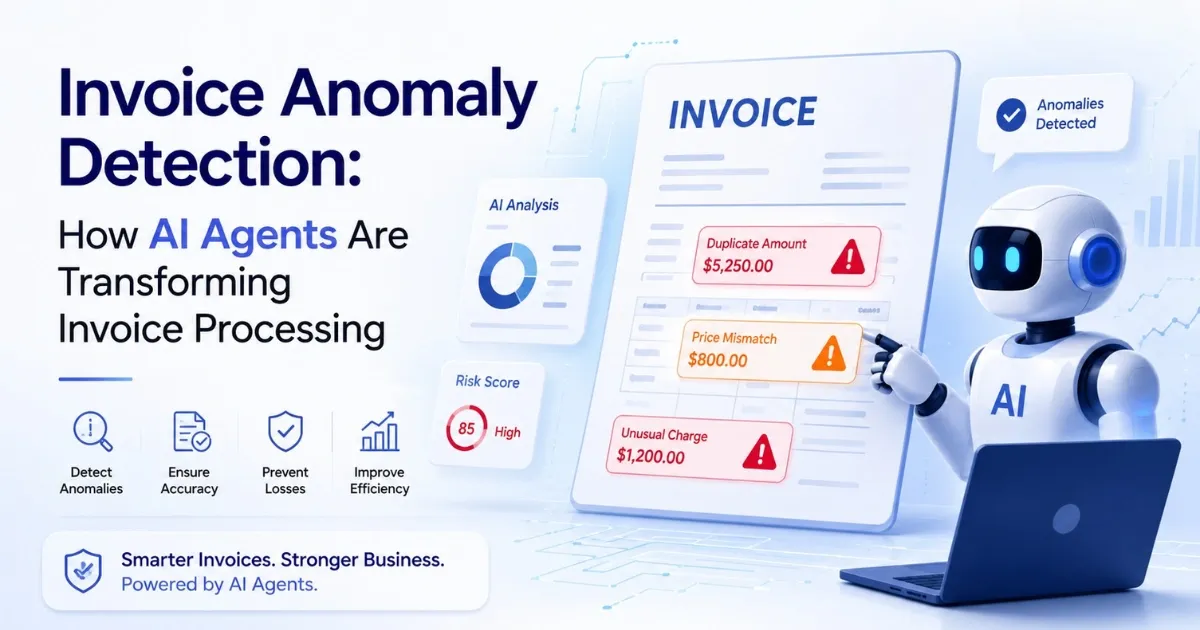
Traditional invoice processing systems are designed to extract information. Modern AI Agents go a step further—they analyze, validate, and reason before an invoice reaches your ERP.
An invoice anomaly is any transaction that deviates from expected business patterns, contractual agreements, procurement policies, or historical supplier behavior.
These anomalies can be intentional, accidental, or caused by process gaps.
Many of these issues are difficult to identify through manual reviews, especially when finance teams are under pressure to process invoices quickly.
Most invoice automation solutions focus on:
While these capabilities reduce manual effort, they do not necessarily identify business risks.
For example:
An OCR engine may correctly extract an invoice amount of $98,750.
But should that amount be approved?
Traditional systems often cannot answer questions such as:
This is where AI Agents make a significant difference.
Unlike rule-based systems, AI Agents evaluate invoices using multiple sources of business context.
Instead of asking, “What does this invoice say?”
They ask, “Does this invoice make business sense?”
An AI Agent can automatically:
AI compares:
Even when invoice numbers differ slightly, the AI can identify suspicious similarities that may indicate duplicate submissions.
The AI Agent compares invoice prices with:
It immediately flags unexpected price increases or unauthorized charges.
Traditional three-way matching checks:
AI enhances this by identifying:
AI continuously learns purchasing behavior.
For example:
These insights help identify anomalies before payment is made.
AI Agents monitor supplier-related risks, including:
These checks strengthen fraud prevention.
AI validates:
Errors are flagged automatically before posting to the ERP system.
Not every anomaly should block invoice processing.
AI assigns a risk score based on the severity of the exception.
These can be auto-approved.
These may require manager approval.
These are routed to finance teams for review.
This allows organizations to automate routine work while maintaining control over high-risk transactions.
Organizations implementing AI-powered invoice validation can expect benefits such as:
Instead of reviewing every invoice manually, finance professionals focus only on invoices that genuinely require attention.
Imagine receiving an invoice from a supplier that has consistently billed around $18,000 each month.
This month, the invoice totals $27,500.
A traditional OCR system extracts the amount correctly and routes it for approval.
An AI Agent performs additional validation:
The invoice is flagged before payment, preventing an expensive overpayment and enabling the finance team to resolve the issue with the supplier.
The next generation of Accounts Payable automation is no longer about digitizing invoices.
It is about enabling AI Agents to make informed decisions before invoices are approved and paid.
By combining document intelligence, ERP integration, procurement data, historical trends, and business rules, AI transforms invoice processing from a reactive task into a proactive financial control function.
Organizations that embrace AI-driven anomaly detection will reduce financial risk, improve operational efficiency, and give finance teams the confidence to process invoices faster without compromising accuracy.
Invoice anomalies are inevitable—but unnoticed anomalies are preventable.
AI Agents empower finance teams to move beyond simple automation by understanding business context, identifying exceptions, and routing only high-risk invoices for review. The result is a smarter Accounts Payable process that minimizes errors, strengthens compliance, and protects cash flow.
As businesses continue to scale, AI-powered anomaly detection will become a core capability for modern finance operations, helping organizations process invoices with greater speed, accuracy, and confidence.