Address
304 North Cardinal St.
Dorchester Center, MA 02124
Work Hours
Monday to Friday: 7AM - 7PM
Weekend: 10AM - 5PM

Address
304 North Cardinal St.
Dorchester Center, MA 02124
Work Hours
Monday to Friday: 7AM - 7PM
Weekend: 10AM - 5PM

 Byadmin
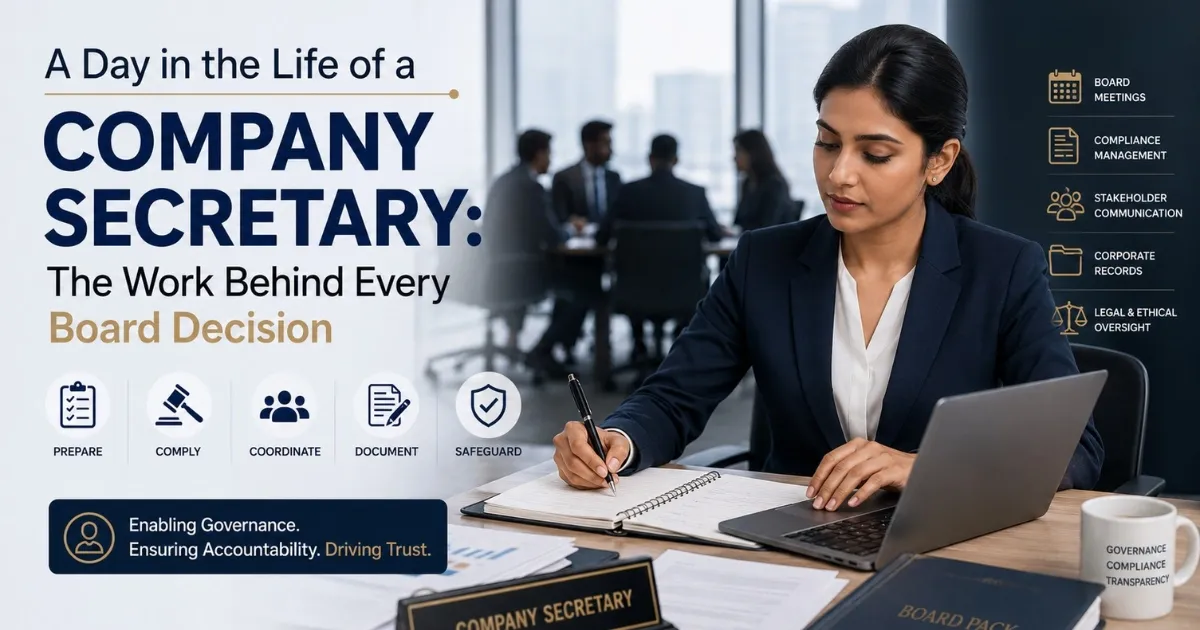
When people think about board meetings, they often picture directors gathered around a conference table discussing strategy, approving budgets, or making decisions that shape the future of an organization.
What they rarely see is the person who makes sure every one of those decisions is properly documented, legally compliant, and capable of standing up to scrutiny years later.
That person is the Company Secretary.
While the role has evolved significantly over the years, one aspect remains constant—the responsibility of ensuring good corporate governance through meticulous preparation, documentation, and compliance.
For many Company Secretaries, the day starts with reviewing emails that arrived overnight.
A director requests an additional agenda item.
The Chair asks for revisions to a proposed resolution.
Legal has suggested a wording change to an important document.
The agenda that seemed final yesterday suddenly requires another round of updates.
Before the actual board meeting even begins, the work has already started.
One of the less visible challenges is finding the correct version of existing documents.
Board Resolution templates may exist across multiple folders.
Previous Minutes could be stored in shared drives, email attachments, or departmental repositories.
Different jurisdictions may require different wording.
Finding the correct precedent often becomes an exercise in detective work.
The question isn’t whether the document exists.
The question is whether it is the latest, approved version.
Unlike many business documents, Board Resolutions and Minutes leave little room for ambiguity.
A single missing clause, incorrect reference, or inaccurate recording of decisions can create compliance concerns later.
Company Secretaries spend considerable time:
The responsibility goes beyond documentation.
It is about creating an accurate legal record of the Board’s decisions.
Preparing for a board meeting involves coordinating with numerous people.
Each stakeholder contributes comments, revisions, and additional requirements.
Managing these inputs requires patience, organization, and exceptional attention to detail.
Often, the final version of a document has gone through multiple rounds of edits before receiving approval.
Ask almost any Company Secretary, and they’ll probably smile at filenames like:
Each revision represents another review, another approval, or another governance requirement.
Keeping track of these versions is a daily responsibility.
Recording Minutes is often misunderstood.
Minutes are not transcripts.
They are official corporate records.
They must accurately capture:
Years later, regulators, auditors, investors, or legal teams may rely on these records.
Accuracy is essential.
Once the board meeting concludes, the work continues.
The meeting itself may last two hours.
The documentation surrounding it may require days.
Good corporate governance often goes unnoticed because, when done well, everything simply works.
Behind all of this is the diligence of the Company Secretary.
Their role combines legal awareness, organizational skill, communication, discretion, and precision.
It is a profession built on trust.
Every signed Board Resolution tells only part of the story.
Behind every approved Minute are hours of preparation, coordination, verification, and careful documentation.
Company Secretaries are more than administrators.
They are custodians of corporate governance, protectors of compliance, and trusted advisors to Boards.
While their work often happens behind the scenes, its impact is visible throughout every well-governed organization.
The next time you see a Board Resolution or a set of approved Minutes, remember that what appears to be a simple document represents hours of careful work, thoughtful coordination, and unwavering attention to detail.
Because in corporate governance, every word matters—and someone is responsible for ensuring every word is right.