Address
304 North Cardinal St.
Dorchester Center, MA 02124
Work Hours
Monday to Friday: 7AM - 7PM
Weekend: 10AM - 5PM

Address
304 North Cardinal St.
Dorchester Center, MA 02124
Work Hours
Monday to Friday: 7AM - 7PM
Weekend: 10AM - 5PM

 Byadmin
For many organizations, contract management started with something remarkably simple:
An Excel spreadsheet.
A list of contracts.
A few columns for contract number, customer, expiry date, renewal date and owner.
It worked — until the organization grew.
More contracts meant more spreadsheets. More business units meant more versions. More stakeholders meant more emails. Eventually, organizations had contracts everywhere but had very little confidence about what those contracts actually meant for the business.
That is where the maturity journey of contract management began.
Today, that journey is entering its next phase Agentic AI-powered contract management.
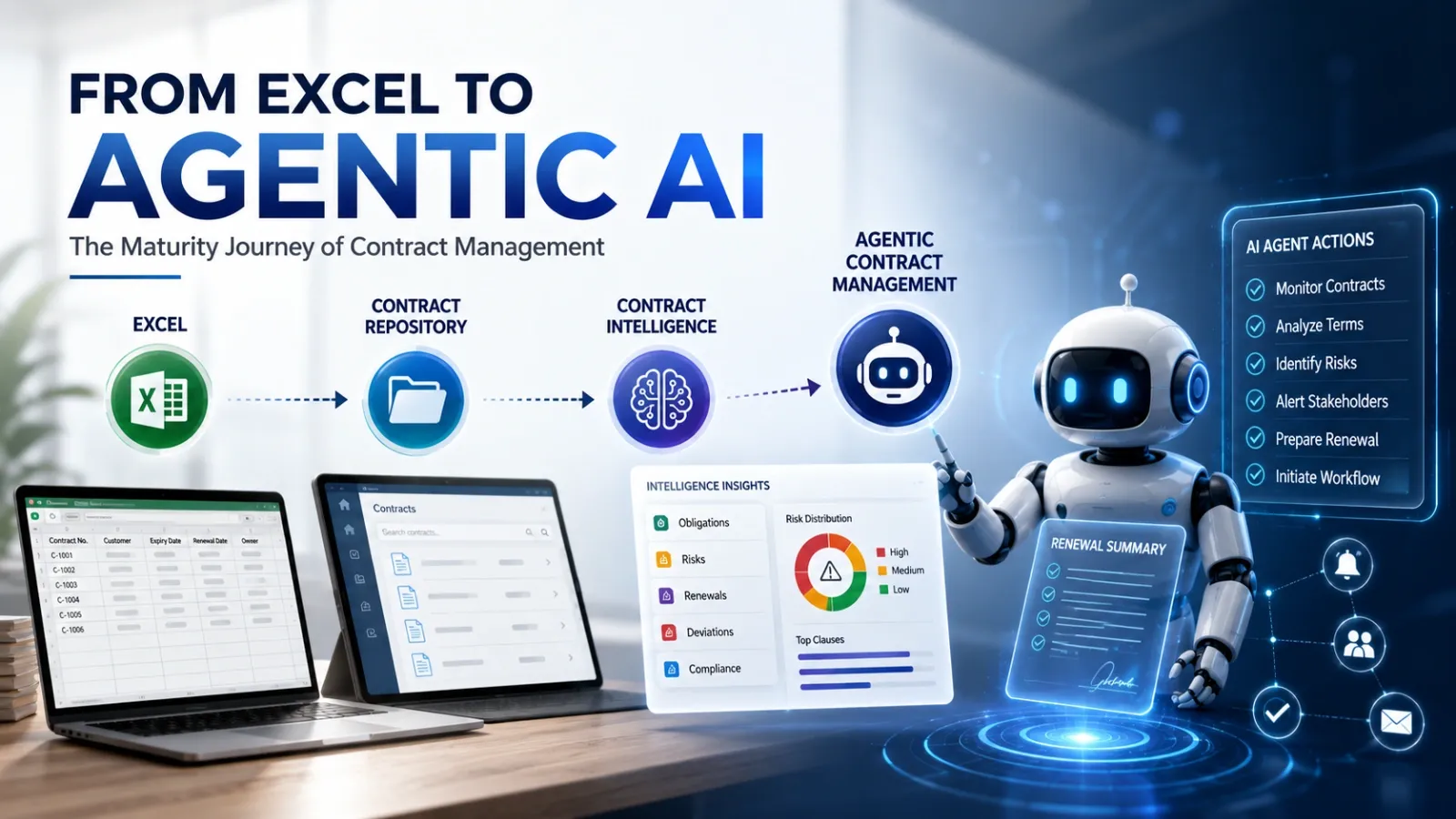
The evolution can be broadly understood in four stages:
Excel → Contract Repository → Contract Intelligence → Agentic Contract Management
And this progression is much more significant than simply replacing one software application with another.
The first stage was primarily about visibility.
Organizations created spreadsheets to answer basic questions:
But Excel was never designed to understand contracts.
The actual contract remained somewhere else in a shared drive, email attachment, document management system or someone’s laptop.
The spreadsheet merely pointed toward it.
The result was a familiar problem:
The organization had contract data, but not contract intelligence.
The next major maturity step was moving from spreadsheets to dedicated applications.
Organizations started building or buying Contract Lifecycle Management (CLM) platforms and contract repositories.
Now contracts could be centralized.
Metadata could be captured.
Users could search contracts.
Renewal dates could trigger notifications.
Approvals could be routed through workflows.
Dashboards could provide management visibility.
This was an important transformation because the contract stopped being just a document sitting in a folder and started becoming structured business information.
The repository became a system of record.
But there was still a fundamental limitation.
The system could tell you:
“This contract expires on September 30.”
It could not necessarily tell you:
“This contract has a 90-day notice period, contains an automatic renewal clause, has a non-standard price escalation provision, and the current commercial terms create a potential margin risk.”
That required humans to read and interpret the contract.
AI changed the equation.
Contracts are largely unstructured data. They contain legal language, commercial obligations, exceptions, dates, dependencies and risk buried inside thousands of pages.
Traditional systems primarily stored this information.
AI can read and interpret it.
This enables capabilities such as:
Instead of searching for a contract, a user can ask:
“Show me all contracts with unlimited liability.”
Or:
“Which supplier contracts have auto-renewal within the next 90 days?”
Or:
“Which customer agreements contain non-standard payment terms?”
This is the point where the contract repository starts becoming a contract intelligence platform.
And the market data suggests this transition is already happening.
According to Icertis’ 2026 State of Contracting report, 44% of organizations are now using AI for contracting workflows, with redlining, contract review and summarization among the leading use cases.
But even more interesting is what comes next.
The next evolution is not simply better document extraction.
It is agentic contract management.
An AI agent can potentially move beyond answering questions and start managing workflows around the contract.
Imagine an agent monitoring your entire contract portfolio.
It identifies that a strategic supplier contract is approaching renewal.
It checks the agreement.
It understands the notice period.
It identifies the commercial terms.
It compares the current pricing with approved benchmarks.
It checks whether obligations have been fulfilled.
It identifies unusual clauses.
It alerts Procurement and Legal.
It prepares a renewal summary.
It drafts the required communication.
And, subject to predefined approval rules, it initiates the next workflow.
That is a fundamentally different operating model.
The system is no longer simply saying:
“Here is your contract.”
It is saying:
“Here is what is happening in your contract portfolio, why it matters, and what needs to happen next.”
World Commerce & Contracting’s 2025 Benchmark Report provides an important perspective.
88% of executives recognize that commercial and contract management excellence matters, yet there remains a significant gap between recognizing the importance and actually taking action.
The report also highlights that AI is forcing organizations to restructure around new capabilities and describes an evolution from transactional workflows toward platforms that can learn, anticipate and act.
There is another important warning in the same research:
48% of respondents acknowledge a lack of clarity over who is accountable for the quality and integrity of the contracting process. WorldCC’s analysis suggests the actual accountability gap may be considerably larger.
This is important because technology alone does not solve a broken contracting process.
You cannot simply take an Excel spreadsheet, put AI on top of it and expect transformation.
The evolution therefore looks something like this:
| Maturity | Technology | Primary Question |
|---|---|---|
| Level 1 | Excel / folders | Where is the contract? |
| Level 2 | Contract Repository / CLM | What contracts do we have? |
| Level 3 | AI Contract Intelligence | What do our contracts say? |
| Level 4 | Agentic Contract Management | What needs to happen next? |
This is the real shift.
From storage → visibility → understanding → action.
There is a temptation today to jump directly to Agentic AI.
That can be a mistake.
Before introducing autonomous agents, organizations need to establish:
1. A defined contract management process
Who creates, reviews, approves, executes, stores and manages contracts?
2. A reliable contract repository
Contracts need to be centralized and accessible.
3. Structured contract data
Key metadata, clauses, obligations and relationships need to be identifiable.
4. Governance and accountability
Who owns the decision? Who approves an AI recommendation? What actions can an agent take autonomously?
5. Human-in-the-loop controls
Not every contract decision should be autonomous. High-risk actions should have appropriate human approval.
WorldCC’s research makes this point particularly well: technology and AI cannot compensate for the absence of consistent processes and accountability.
The traditional contract repository was essentially a digital filing cabinet.
The modern repository is becoming a knowledge layer for the organization.
And the next generation could become an active contract management system.
Instead of users constantly asking:
“What do I need to check?”
The system starts telling them:
“Here is what requires your attention.”
Instead of Legal spending hours searching hundreds of agreements, AI can surface the relevant contracts, clauses and risks.
Instead of Finance discovering commercial leakage after the fact, contract intelligence can identify deviations and obligations earlier.
Instead of Procurement manually monitoring every renewal, agents can continuously monitor the portfolio and initiate the appropriate workflow.
That is the promise of Agentic AI.
This transformation is not fundamentally about eliminating Legal, Procurement or Contract Management teams.
It is about changing where their time is spent.
Humans should increasingly focus on:
AI should increasingly handle:
Icertis’ 2026 research reinforces how quickly this is moving: 53% of executives expect AI agents to autonomously negotiate customer or supplier deals within the next 12 months, although concerns around data quality, trust and autonomous decision-making remain significant.
That combination — rapid adoption + strong governance requirements — is likely to define the next stage of contract management.
The biggest change in contract management may therefore not be the application itself.
It is the change in the role of the contract.
Yesterday, the contract was a document.
Then it became a record.
Today, it is becoming structured intelligence.
Tomorrow, it could become an active business agent capable of monitoring, reasoning and initiating actions within defined boundaries.
The organizations that understand this maturity journey will not simply ask:
“Which contract management software should we buy?”
They will ask a much more important question:
“How far do we want our contract management capability to evolve?”
Because the journey from Excel → Repository → Intelligence → Agentic AI is not merely a technology upgrade.
It is the transformation of contract management from record keeping into an intelligent business capability.